
Grand Rapids City Directory Collections
Grand Rapids has a layered directory shelf rather than one continuous book. The Grand Rapids History Center holds the local sequence, including microfilm listed for 1856 through 1956 and a separately cataloged run from 1859 through 1998. Grand Rapids City Archives lists Polk city directories beginning in 1865. Later coverage shifts to Kent County-East and Kent County-West Polk volumes, so a search near the city boundary needs the right edition instead of a city-only assumption.
| Collection | Years | Where held | Access route |
|---|---|---|---|
| Williams Grand Rapids Directory, City Guide and Reference | 1859/1860 | GRPL History Center, Collection 301 | Physical archive; condition and copying limits apply |
| Grand Rapids Directory Company and R.L. Polk volumes | 1856-1956 microfilm; 1859-1998 cataloged run | GRPL History Center and public-service area | In-library use and catalog consultation |
| Digitized Grand Rapids directory editions | 1859-1933 in HathiTrust; 1856-1924 in Google Books | Online editions linked by local history resources | Free-view availability varies by edition |
| Grand Rapids Suburban and Kent County East/West directories | 1957-1997 suburban; East/West 1998-present | GRPL catalog, History Center, reference shelves | Use the municipality-specific volume |
| Annotated street index | 1912 base with later notes within 1927 boundaries | GRPL in-library cataloged item | Address-conversion reference |
The catalog records gaps for 1947, 1950, 1952, 1957, 1989, and 1991. A “complete set” description means the cataloged set, not that every calendar year was printed. Note the missing year in a research log and use the nearest surrounding edition.
Grand Rapids Directory Origins
The earliest documented item is the 1859/1860 Williams Grand Rapids Directory, City Guide and Reference in Collection 301. The Polk line becomes the main long-running local spine from 1865 in the City Archives listing. Together, those holdings make it possible to move from an early name listing to later address and business entries without pretending that the run has no breaks.
Grand Rapids became a city in 1850, and the directory sequence begins close to that early city period. The 1912 address conversion is the key divide in the record trail, not a reason to discard an earlier entry. The 1912 street index and Sanborn maps supply the bridge between the old and later numbering systems.
| 1859/1860 | Williams volume documented in GRPL Collection 301 |
|---|---|
| 1865 onward | Polk city directories listed by Grand Rapids City Archives |
| 1912 | Citywide address-system change tied to the Fulton and Division baseline |
| 1998 onward | Kent County-East and Kent County-West Polk coverage at GRPL |
Note: A changed house number around 1912 requires the address bridge before comparing directory entries across the change.
Grand Rapids City Directory Access
The History Center is on Level 4 of the Main Library and brings city and telephone directories together with newspaper microfilm, obituary indexes, yearbooks, property files, listing cards, photographs, and plat indexes. Some databases are library-only or available only to cardholders, and an index may point to a physical source. Staff can provide research help, while intensive family-history work may be referred to the Western Michigan Genealogical Society.
GRPL Family History resources also point researchers to city archives, cemeteries, genealogy databases, Michiganology, and the local directory collection. City Archives holds its Polk volumes alongside assessment cards, tax rolls, permits, maps, and other city series. Archive access is by appointment, which makes it a useful fallback when an entry or address needs to be checked against a municipal record.
A view of the Grand Rapids History Center shows the local-history setting where the directory, microfilm, and related reference layers are brought together.
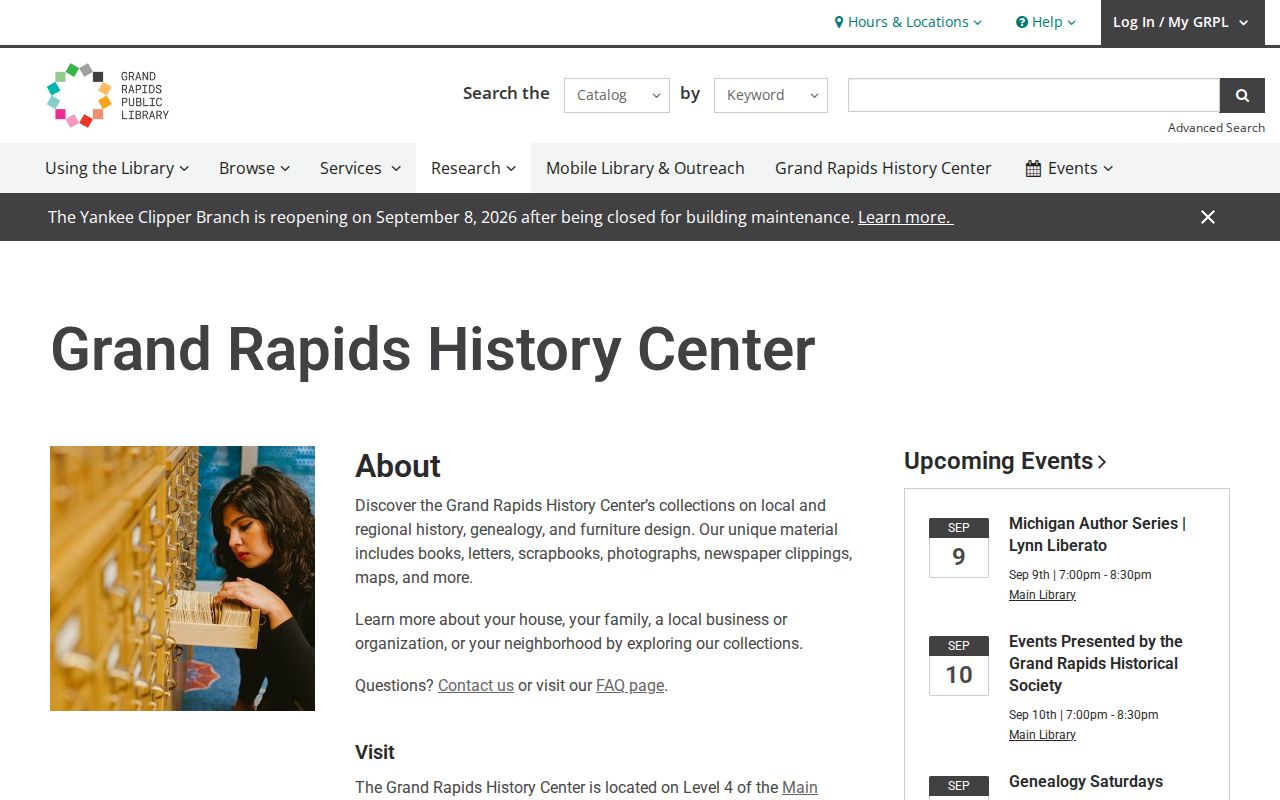
The center matters because a directory entry can be tested against nearby newspaper, property, map, or obituary material without treating a single listing as conclusive.
Grand Rapids City Directory Online
Digitized editions widen access, but they do not replace the local shelf. HathiTrust has selected Grand Rapids volumes from 1859 through 1933, while Google Books has selected editions from 1856 through 1924. The Google Books directory record is a practical starting point for searchable or full-view editions, subject to each edition’s access setting. The GRPL House History guide and Grand Rapids Historical Society also link to digitized runs.
Search the surname by itself first. Directory type can set names in initials, abbreviate a given name, or divide a firm name from its proprietor. A printed or scanned page should be recorded with the edition year and page, because a later index may reproduce a name differently.
The digitized Grand Rapids directory editions make the older page layout visible before a researcher visits the library for a different year.
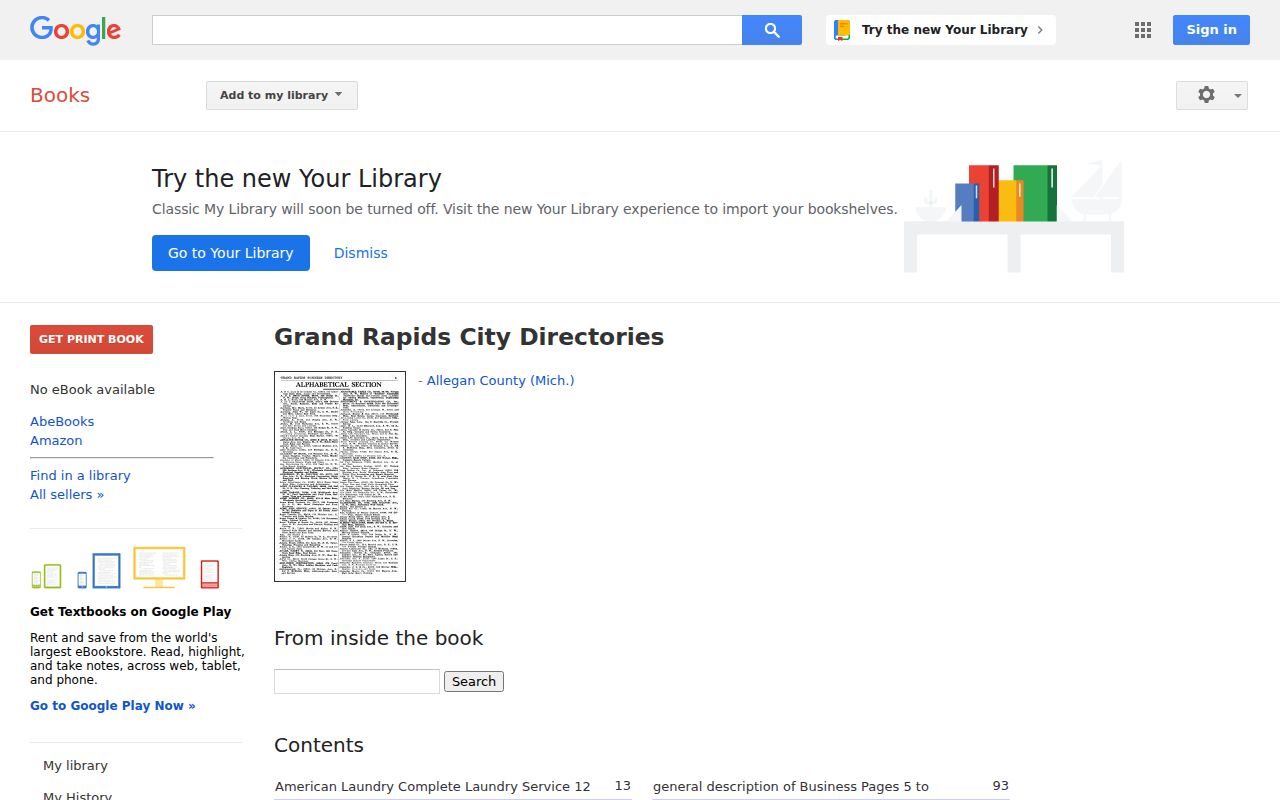
Online editions are best used to identify a likely year, spelling, or address, then compared with the relevant local volume and related records.
Reading Grand Rapids City Directory Entries
A Grand Rapids city directory normally separates alphabetical resident and business entries from a street or address index. A name entry may give the surname, initials or given name, occupation or trade, street address, and a residence notation. A business entry can add the firm, trade, proprietor or manager, address, telephone, or classified placement in later volumes. Read the abbreviation key in that same edition before expanding a mark.
| Name form | Surname, given name, initials, and sometimes a spouse or household reference |
|---|---|
| Residence line | Street address with “res” where used for residence |
| Occupation | Trade, work, firm, or business clue as printed |
| Street section | House number, street, occupant or business, and cross-reference |
| Edition shorthand | Examples include “bds” for boards, “opp” for opposite, “wid” for widow, and directional corner shorthand |
- Criss-cross directory
- A street-order or reverse-address section used to approach a household from the address rather than the surname.
- Householder index
- An alphabetical resident listing that helps anchor a name before checking the street-order section in the same edition.
- Abbreviation key
- The edition-specific explanation for shortened words and directional marks; photograph or transcribe it with the entry.
A directory listing is an occupancy and contact clue. It does not establish ownership, which should be tested with tax-roll or deed records.
Grand Rapids Directory Gap Check
Do not let the long run create a false sense that every annual volume exists. The missing publication years are part of the evidence. A family can appear at one address before a gap and at another after it, but the move date remains unproven until another record supplies it. Check the exact Grand Rapids, suburban, East, or West title because the catalog describes different geographic series.
The GRPL city-directory list is useful for confirming the available microfilm and run notes before a trip to the History Center.
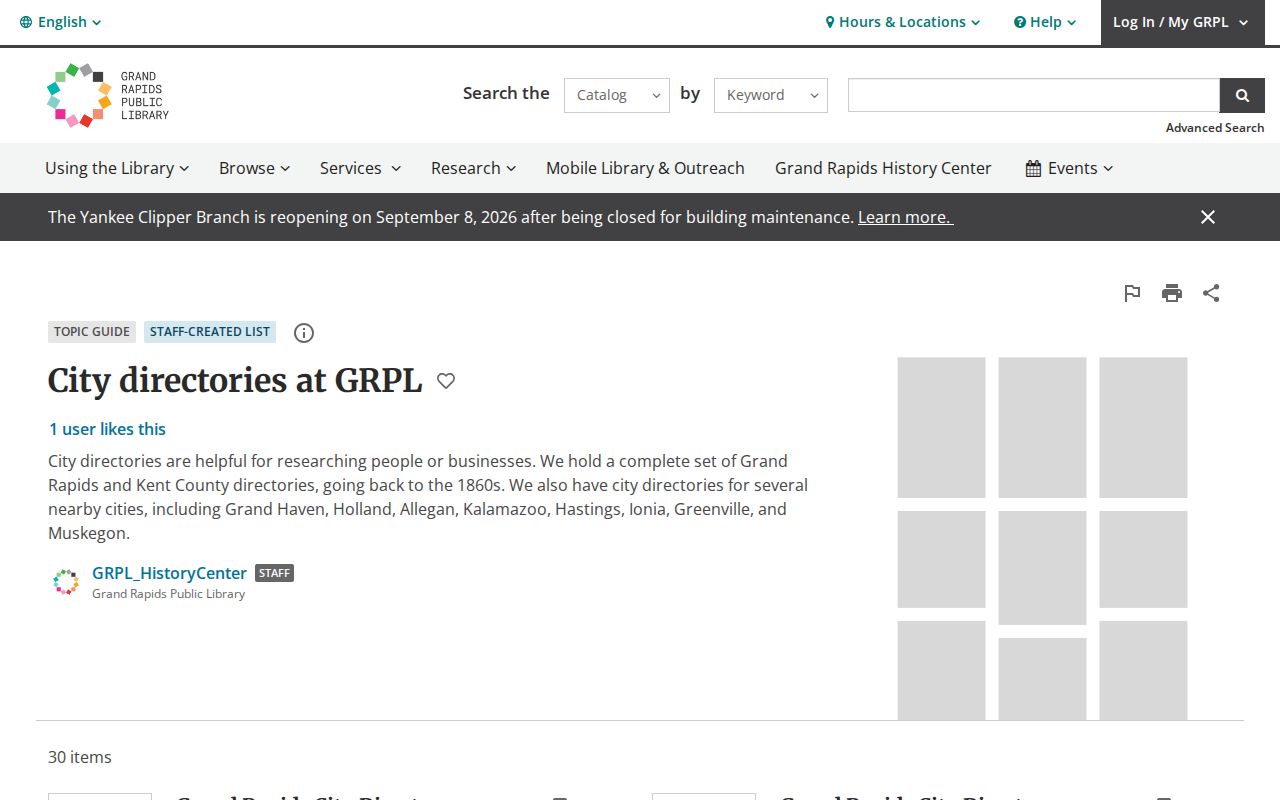
The list makes the publication gaps visible, so a search can move to an adjacent edition or a companion record without filling in a missing year by guesswork.
Grand Rapids 1912 Directory Bridge
Grand Rapids changed its address system citywide in 1912 around the Fulton Street and Division Avenue baseline. An address before that change may not match the later house number or quadrant. The annotated 1912 City Directory Street Index records the base numbering with subsequent changes and notes within the 1927 boundaries. It should be consulted before comparing a pre-1912 directory entry with a later record.
The 1912 Sanborn map and the local street index are complementary tools. The index translates the street-address problem, while the map can show old and new numbering, building context, and the surrounding block. That is why an address mismatch is not enough to rule out a family connection.
Note: Preserve both the printed address and the translated address in a research log so later sources can be checked on their own terms.
Tracing Grand Rapids City Directories
Household tracing starts in the nearest available edition and works outward, one volume at a time. The aim is to retain what the book actually says, including initials, occupation, a spouse notation, business name, and street address. Pair the annual address clue with census material, which offers household composition on the enumeration date. Federal census records are public through 1950 as of the research date, so later household questions need other sources.
- Find the person, business, or street in the nearest available directory year and record the edition and page.
- Check both the alphabetical entry and the reverse street or address section, searching a business and its proprietor separately.
- Move backward and forward one available edition at a time, preserving exact spellings, initials, address changes, and catalog gaps.
- Use the 1912 bridge before matching an earlier address to a later address or Sanborn map.
- Pair directory years with the applicable census, then test a later transition with a deed, assessor record, obituary, or probate file.
The historical shelf is covered in detail here; a modern parcel or address question belongs with the Grand Rapids by-street directory. A disappearance from a directory can reflect a move, death, business change, omission, or an unprinted year, so it needs a second source.
Grand Rapids Directory Newspaper Checks
Newspapers can explain why a name changes or stops appearing. GRPL reports that early local newspapers begin in the 1840s with missing issues, and its Press indexes cover 1893-1922 and 1982-2005, with selected 1957-1986 material in another index. The Western Michigan Genealogical Society indexes Grand Rapids Press and Herald obituaries from 1910 forward. Those sources can help distinguish a move from a death or an estate transition.
GRPL launched a local newspaper search tool and viewer in 2025, adding local titles. The GRPL historical newspapers collection also identifies access limits, including library-card and library-only material.
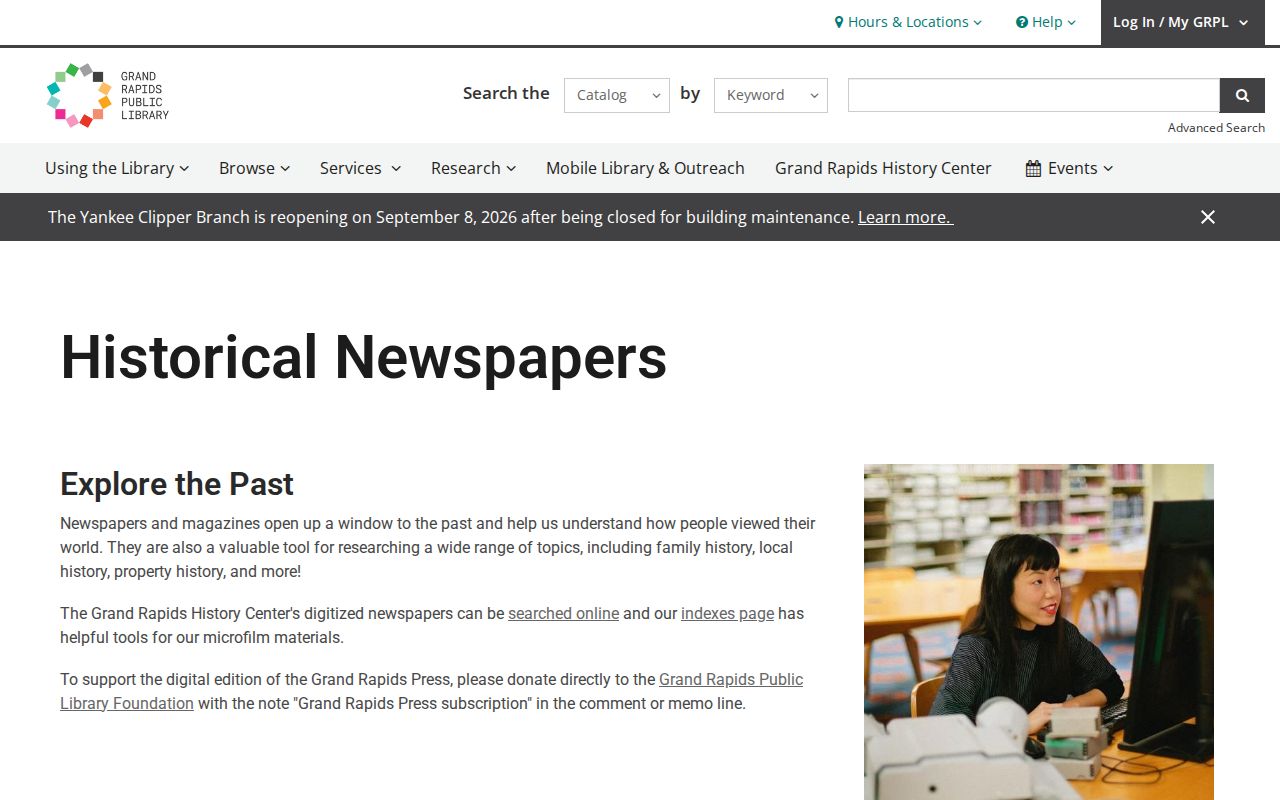
A directory date plus a newspaper notice makes a stronger timeline than either record alone, particularly where a cataloged directory year is missing.
Grand Rapids Directory Companion Sources
Directory occupations can be a useful lead into Grand Rapids’ furniture-industry collections. GRPL holds trade catalogs and company records for Widdicomb, American Seating, Baker, Berkey & Gay, Steelcase, Stickley, Stow & Davis, and related firms. An occupation such as cabinet maker, finisher, machinist, designer, or manufacturer should be copied exactly before checking those collections.
Family-history research can also use yearbooks, church-index references, plat indexes, cemetery material, and obituary indexes held or linked by GRPL. The library’s family-history resources show the range of local indexes and restricted databases that can provide the next record lead.
These companion sources add context to a directory entry without changing its basic limit: the printed line records what that particular edition chose to publish.